Mantis Beings
Mantis beings, also called Mantids or insectoid beings, are a distinct class of non-human intelligence reported across contact and abduction accounts worldwide, described as tall, thin, upright figures with large bulging or compound eyes, an elongated triangular head, and the overall bearing of a praying mantis. Within the wider taxonomy of reported entities they stand alongside Greys, Nordics, and Reptilian beings, though their formal published literature remains thin by comparison. Documentation within the experiencer community, by contrast, is extensive and still growing, built through individual case write-ups, abduction-researcher interviews, and firsthand accounts rather than the bestselling books and sustained press coverage that established the other widely reported types. The living record describes them as robed figures of rank, and a large share of firsthand accounts describes them as kind, ancient, and wise.
Main characteristics
Physical description
Reports commonly describe a tall figure, ranging from around five to seven feet, thin-bodied, with large bulging or compound eyes, an elongated or triangular head, and limbs and posture reported as insect-like. Some accounts describe additional or unusual limb counts. Communication is sometimes described as a clicking sound rather than, or alongside, the telepathic communication reported for Grey beings.
Robes and rank
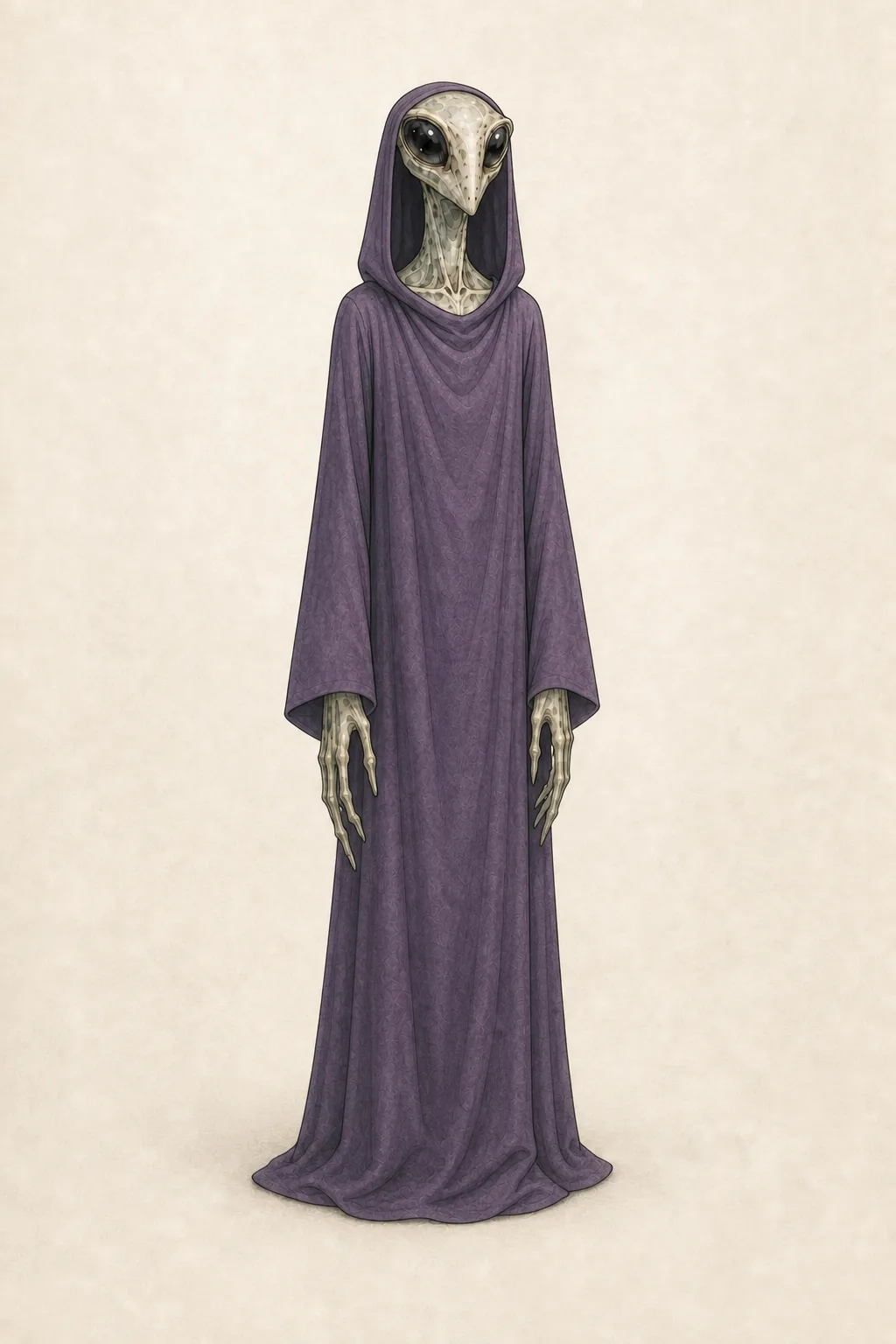
Clothing is one of the record's most consistent motifs, documented across the community literature and the dedicated case archives. Experiencers in unrelated accounts describe long robes in a range of colors, alongside occasional capes and cloaks and the close-fitting tunics and jumpsuits of the early case files.1,4,5 Purple robes carry a specific reading. Across accounts with no connection to one another, they are taken to mark seniority or high rank, and experiencer Simon Parkes states the convention most directly, reporting that the beings in purple robes are the most senior.4 The clothing itself separates the type from Greys, who are almost never described clothed, and the community record treats the garments as meaningful rather than incidental, the visible dress of a being experiencers describe as holding rank.
Reported behavior
Accounts vary. Some describe Mantis beings observing rather than directly interacting with the witness. Others describe a supervisory or directing role, similar in structure to how some Reptilian reports are framed, occasionally described as overseeing Grey beings within a single reported encounter.
Historical development
Isolated reports describing insect-like or "grasshopper" beings appear earlier than the category's wider circulation. A 1967 case from Catalina Island, California, investigated by researcher Paul Nelson, involved reported missing time and a hypnotic-regression session describing such a figure. A 1973 case near Interstate 70 in Maryland, and a 1987 case reported in the Yukon, Canada, both described beings witnesses called "grasshopper people."1
Researcher Martin S. Kottmeyer, reviewing the case record, identified a marked increase in reports beginning around 1990, with roughly two dozen documented cases identifiable by that point and further cases continuing through the following decades.1 Temple University historian David M. Jacobs, noted for his Grey-focused abduction research, has separately written about mantis-type beings occupying a significant position within the wider reported hierarchy of non-human types.1,2 More recent public experiencers, among them former UK town councillor Simon Parkes, describe contact with Mantis beings in explicitly spiritual or channeling terms rather than through the hypnotic-regression research model used in earlier decades.1,9
Contemporary discussion also associates Mantis being reports with DMT and other entheogenic experiences, an association that developed separately from the earlier case-based abduction research and now carries published survey work of its own. From the late 2010s onward, dedicated community archives began gathering firsthand Mantis accounts in one place, giving a category once documented through scattered case write-ups a concentrated and steadily growing documentary base.5
Mantis beings in contact literature
Within the wider reported taxonomy that also includes Greys, Reptilians, and Nordics, Mantis beings are most often described as occupying a supervisory or directing position, sometimes reported as present at the periphery of an encounter rather than as the primary figure a witness interacts with. Some abduction-research literature places them at or near the top of an informal reported hierarchy. Other accounts describe them as a separate and unrelated category encountered on their own. Within the experiencer community, the type also appears entirely on its own terms, encountered by individuals with no abduction narrative at all, and the tone of those firsthand accounts is markedly warmer than that of the regression-era files.
Reported roles and demeanor
Across the case files and the community archives, a small set of roles recurs with enough regularity that the record treats them as the type's working repertoire. No single account contains all of them, and the same being is sometimes described moving between roles within one encounter.
Healer and surgeon
A substantial share of accounts place the Mantis being at the center of medical or quasi-medical procedures, presiding with evident care. The community literature records experiencers describing the beings as skilled surgeons, and individual accounts describe a figure who urged the witness to stay calm and telepathically reassured them that everything would be all right.4 In many of these accounts the procedural work is carried out by Grey beings while the Mantis directs it and steadies the witness.
Teacher and guide
Other accounts describe instruction, with knowledge shown or transferred, guidance delivered mind to mind, and counsel the experiencer describes as coming from something far older than themselves. The teaching accounts are among those most often reported from meditation rather than abduction contexts, and the community archive documents them as a standing category of the record.5
Midwife and attendant
In reproductive-themed accounts, a Mantis being is described attending procedures involving pregnancy or the presentation of infants, present as a midwife or senior attendant rather than an examiner. The community archive documents these accounts alongside the medical ones, and they share the same reported quality of gravity and care.5
Overseer and director
The overseer role is the oldest in the record and remains part of it. Abduction-era files describe the Mantis at the periphery of an encounter, directing Grey beings who perform the procedural work, and researchers including David M. Jacobs place mantis-type figures at or near the top of the reported hierarchy.1,2 The community literature describes the same structure, a supervisory presence within the procedure process rather than a hands-on examiner.4
Demeanor and emotional depth
The emotional register of the record has deepened as the record has grown. The older abduction literature emphasized a colder, supervisory presence, with Jacobs reading the agenda of his cases in dark terms and early files recording fear, including a London experiencer's years of frightening nighttime visitations.1 The living record has filled in what those files left out. A large share of contemporary accounts describe overwhelming feelings of love, familiarity, or reassurance in the being's presence, and describe the being itself as kind, ancient, and wise.4,5 Experiencers who report fear typically locate it in the first moments of an encounter and describe it giving way to calm. Read together, the two layers deepen rather than contradict one another. The early files recorded the role. The accumulating firsthand record has recorded the relationship.
Settings of reported encounter
Mantis encounters are reported from the classic abduction setting, aboard a craft within a larger structured event, but the community archives document three further settings recurring with particular consistency, and the distribution of accounts across them is itself a feature of the record.5
Bedside visitation
The most commonly documented setting outside abduction is the bedroom at night. Experiencers describe waking in the early hours to find a tall Mantis figure standing at or near the bed, observing, sometimes communicating, and then gone. One account in the community literature describes waking at around half past two in the morning to a praying-mantis figure at the bedside.4 These accounts sit within the wider pattern of bedroom visitation, and their reported tone runs from serene to, in a minority of cases, frightening.1
Meditation and hypnagogic states
A second cluster arises from deep meditation and the hypnagogic threshold between waking and sleep. Practitioners of contact meditation describe Mantis figures arriving unbidden in the middle of a session, and meditation-context accounts form one of the standing categories of the dedicated archive.5 These accounts skew strongly toward the teaching role, and experiencers frequently describe them as the gentlest in the record.
Psychedelic experience and the DMT connection
The category's best-documented external anchor now comes from psychedelic research. In government-funded clinical work at the University of New Mexico School of Medicine between 1990 and 1995, Rick Strassman administered roughly 400 doses of DMT to nearly 60 volunteers, and more than half reported profound encounters with nonhuman beings, some of which Strassman describes as resembling insects and aliens. His 2001 book DMT: The Spirit Molecule brought those reports into wide circulation.6 Later survey work has measured the pattern. A 2022 analysis in Scientific Reports of 3,778 firsthand DMT experience reports found entity contact in 45.5 percent of them, identified a distinct category its authors labelled "insectoid, praying mantis, or arachnoid" figures, and found benevolent, comforting, or protecting interactions the most common kind reported.7 A 2020 Johns Hopkins survey of 2,561 people reporting a DMT entity encounter found love, kindness, and joy the most prominent emotions both felt by the respondent and attributed to the entity, with most respondents describing the being as conscious, intelligent, and benevolent.8 The DMT thread developed separately from the case-based abduction research of the 1960s through the 1990s, which makes the recurrence of the mantis figure across both records one of the category's most discussed features.
Leading interpretations
These interpretations are not mutually exclusive, and a fuller account of the Mantis type may well combine more than one of them. Because the case record is smaller than for the other reported types, every well-recorded encounter adds meaningfully to it.
| Interpretation | Core claim | What it requires to be true |
|---|---|---|
| Literal extraterrestrial visitor | Mantis beings are an autonomous non-human species reported alongside other types. | Reported consistency across a still-small number of independent witnesses reflects a real, shared external phenomenon. |
| Reported hierarchy member | Mantis beings occupy a supervisory or directing role over other reported non-human types. | A structured non-human presence exists in which different reported types occupy different roles. |
| Psychological and cultural construct | Some researchers of memory and culture suggest the image spread through a recent pool of case reports, regression sessions, and community discussion. | A comparatively short circulation history is sufficient to establish a shared image without requiring an external cause. |
| Archetypal or symbolic figure | The insect-humanoid image draws on older folklore and mythological insect and hybrid figures. | The pattern reflects a recurring feature of human symbolic thought rather than a specific external cause. |
Documentation and research record
The formal published record consists of individual case write-ups, including the 1967 Catalina Island case, the 1973 Maryland case, and the 1987 Yukon case, together with survey work such as Kottmeyer's review of the roughly two dozen cases identifiable by the early 1990s.1 Witness testimony has been gathered through direct interviews and, in a substantial portion of cases, through hypnotic-regression sessions, and readers weighing individual cases benefit from knowing which method produced them. Abduction researchers including David M. Jacobs have written about mantis-type beings within the wider reported hierarchy of non-human types, and that formal literature remains small.2
Community documentation, by contrast, is now extensive and growing. A dedicated archive, r/MantisEncounters, organizes firsthand accounts by encounter type, including bedroom visitation, meditation, and psychedelic contexts, and steady accounts appear across the wider experiencer community at r/Experiencers.5 The published psychedelic-survey literature has begun to meet this record from the other direction, with the University of New Mexico research and the later entity-encounter surveys documenting insectoid and mantis-type figures within their broader data.6,7,8 The record is testimony-based, and the categorized archives now give investigators what the scattered files of the 1990s never provided, a single organized body of firsthand accounts large enough for the type's patterns to be read clearly.
The record and open questions
Documented: Case reports describing an insect-like humanoid figure appear from at least the late 1960s, with researchers identifying a marked increase in case volume around 1990. The category's press, publishing, and academic footprint remains smaller than for Greys, Nordics, or Reptilian beings, while dedicated community archives now document firsthand accounts by encounter type and published psychedelic-survey research records insectoid and mantis-type figures among reported entity encounters.
Reported: Witnesses and abduction researchers describe a tall, thin, insect-like figure, frequently robed, often in a supervisory or directing role relative to other reported non-human types, described in a large share of contemporary accounts as kind, ancient, and wise, with communication reported as clicking sounds or telepathy.
Open questions: What the accounts ultimately describe, how the robes and their colors should be read, and how the Mantis type fits within the wider reported taxonomy are the questions the field is actively working to resolve. The formal case literature is still small while the community record grows quickly, and each new well-documented firsthand account brings the broader patterns into sharper relief.
Frequently asked questions
Are Mantis beings real?
Mantis beings are a documented, recurring feature of contact and abduction testimony, though with a smaller case record than Greys, Nordics, or Reptilian beings. Whether the accounts describe an external being remains an open question, as it does for other entities in the contact literature, and the record continues to grow as new firsthand encounters are documented.
How are Mantis beings different from Greys?
Reports describe a taller, thinner, more clearly insect-like figure than the classic Grey description, and Mantis beings are more often reported in a supervisory or directing role rather than the procedural, examination-focused role typically reported for Greys.
Why do Mantis beings wear robes?
The record is consistent about the fact even though it does not settle the purpose. Experiencers across unrelated accounts describe long robes in a range of colors, with purple robes repeatedly read as marking seniority or high rank, a reading documented across the community literature and stated most directly by experiencer Simon Parkes. Within the community literature the robes are most often understood as marks of office or ceremony, and the clothing itself separates Mantis beings from Greys, who are almost never described clothed.
Are Mantis beings benevolent?
A large share of accounts describe them that way. Experiencers report overwhelming feelings of love, familiarity, or reassurance in their presence and describe the beings as kind, ancient, and wise. The 2020 Johns Hopkins survey of DMT entity encounters found love, kindness, and joy the most prominent emotions in such experiences, and the older abduction literature's colder, supervisory portrait now sits within a much larger record whose prevailing tone is warm. Fear appears in a minority of accounts, most often in the first moments of an encounter.
When did Mantis being reports begin?
Isolated accounts of insect-like beings appear from the late 1960s, and researcher Martin S. Kottmeyer's review of the case record identifies a clearer increase in reports beginning around 1990.
Are Mantis beings connected to DMT experiences?
Yes, and the connection is documented. Rick Strassman's clinical research at the University of New Mexico in the early 1990s recorded volunteers describing encounters with beings, some resembling insects, and a 2022 analysis of 3,778 firsthand DMT reports in Scientific Reports documents a recurring insectoid and praying-mantis category among the entities described. The DMT thread developed separately from the case-based abduction research of the 1960s through the 1990s, and the recurrence of the mantis figure across both records is one of the category's most discussed features.
Do Mantis beings appear in other reported non-human taxonomies?
Yes. Contact and abduction literature frequently places Mantis beings alongside Greys, Reptilians, and Nordic beings within a single reported hierarchy, though accounts differ on the details of that structure.
Sources and further reading
- Edward Crabtree. "The Real Aliens: A Survey of 'Praying Mantis' Entity Reports." Unexplained Mysteries. https://www.unexplained-mysteries.com/column.php?id=312380
- Wikipedia. "David M. Jacobs." https://en.wikipedia.org/wiki/David_M._Jacobs
- Wikipedia. "Alien abduction." https://en.wikipedia.org/wiki/Alien_abduction
- Time for Disclosure. "Mantis-Insectoid Alien Beings." https://timefordisclosure.com/mantis-insectoid-alien-beings/
- r/MantisEncounters community case archive. Reddit. Accessed July 2026. https://www.reddit.com/r/MantisEncounters/
- Wikipedia. "Rick Strassman." https://en.wikipedia.org/wiki/Rick_Strassman
- D. W. Lawrence, R. Carhart-Harris, R. Griffiths, and C. Timmermann. "Phenomenology and content of the inhaled N,N-dimethyltryptamine (N,N-DMT) experience." Scientific Reports 12, 8562 (2022). https://www.nature.com/articles/s41598-022-11999-8
- Alan K. Davis, John M. Clifton, Eric G. Weaver, Ethan S. Hurwitz, Matthew W. Johnson, and Roland R. Griffiths. "Survey of entity encounter experiences occasioned by inhaled N,N-dimethyltryptamine: Phenomenology, interpretation, and enduring effects." Journal of Psychopharmacology 34, no. 9 (2020). https://pubmed.ncbi.nlm.nih.gov/32345112/
- The Scotsman. "'I fathered an alien', says Labour councillor." June 19, 2013. https://www.scotsman.com/news/i-fathered-an-alien-says-labour-councillor-1570795
Categories: Reported entities